Loading...
Searching...
No Matches
gpio.hpp File Reference
GPIO abstraction split into explicit input and output classes. More...
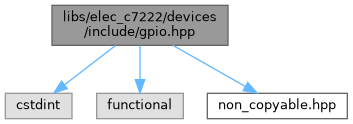
Include dependency graph for gpio.hpp:
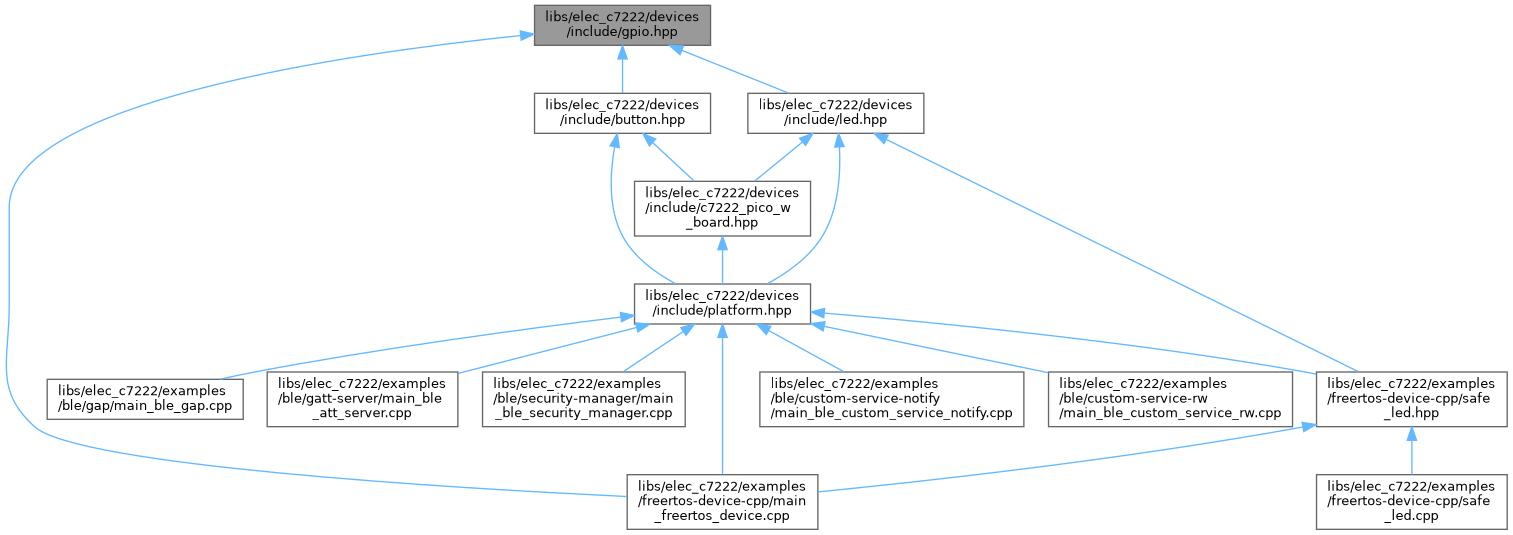
This graph shows which files directly or indirectly include this file:
Go to the source code of this file.
Classes | |
| class | c7222::GpioIn |
| GPIO input-only wrapper with pull configuration and optional IRQ. More... | |
| struct | c7222::GpioIn::Config |
| Configuration structure for input GPIO setup. More... | |
| class | c7222::GpioOut |
| GPIO output-only wrapper with output configuration and drive strength. More... | |
| struct | c7222::GpioOut::Config |
| Configuration structure for output GPIO setup. More... | |
Namespaces | |
| namespace | c7222 |
| C7222 course abstractions namespace. | |
Enumerations | |
| enum class | c7222::GpioPullMode { c7222::None , c7222::PullUp , c7222::PullDown } |
| GPIO pull configuration. More... | |
| enum class | c7222::GpioOutputType { c7222::HighZ , c7222::PushPull , c7222::OpenDrain } |
| GPIO output type. More... | |
| enum class | c7222::GpioDriveStrength { c7222::mA2 , c7222::mA4 , c7222::mA8 , c7222::mA12 } |
| GPIO drive strength. More... | |
| enum class | c7222::GpioInputEvent : uint32_t { c7222::None = 0x00 , c7222::LevelLow = 0x01 , c7222::LevelHigh = 0x02 , c7222::BothLevels = 0x03 , c7222::FallingEdge = 0x04 , c7222::RisingEdge = 0x08 , c7222::BothEdges = 0x0c , c7222::All = 0x0f } |
| GPIO input event bitmask for IRQ configuration. More... | |
Detailed Description
GPIO abstraction split into explicit input and output classes.
Design principles:
- Separate input and output roles:
GpioInandGpioOutare distinct classes. This prevents accidental misuse (e.g., writing to inputs or reconfiguring outputs as inputs) and keeps configuration options focused on what each direction actually needs. - Single ownership per pin: Each GPIO pin is owned by at most one
GpioInorGpioOutinstance at a time. Platform backends track pin ownership and assert if a second object is constructed for the same pin. - Config-as-state: Each class has a
Configstruct that captures all relevant configuration fields. The object stores a cached config andConfigure()reapplies it on the platform backend. - Minimal, explicit API: Inputs expose
Read()and IRQ management; outputs exposeWrite()andToggle(). This keeps the surface small for junior programmers and reduces ambiguous behaviors.
Platform integration (Raspberry Pi Pico W):
- The Pico backend lives in
platform/rpi_pico/gpio.cppand maps these abstractions onto the Pico SDK (hardware/gpio.h). - Input handling:
gpio_init()initializes the pin.- Pull configuration uses
gpio_disable_pulls,gpio_pull_up, orgpio_pull_down. - Direction is set to input (
GPIO_IN). - Optional IRQs are enabled via
gpio_set_irq_enabled_with_callback. The backend stores a per-pin map from GPIO number to a singleGpioIninstance. This enforces one input object per pin and ensures a single callback dispatch target.
- Output handling:
gpio_set_drive_strength()applies pad drive strength.- For push-pull output, the pin is set
GPIO_OUTand driven high/low. - For open-drain output, the SDK has no native open-drain mode; the backend emulates it by switching direction:
- Drive low: set output low and
GPIO_OUT. - Release high: set
GPIO_IN(high-Z) so an external/internal pull-up can pull the line high.
- Drive low: set output low and
- The backend tracks one
GpioOutper pin and asserts on duplicates.
Platform integration (grader backend):
- The grader backend provides stub implementations that compile and mirror the API shape without touching hardware.
- It also enforces the same one-object-per-pin rule for consistency.