LED wrapper that prevents simultaneous control from multiple threads. More...
#include <safe_led.hpp>
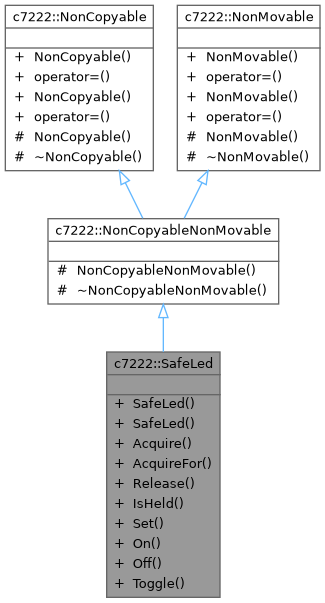
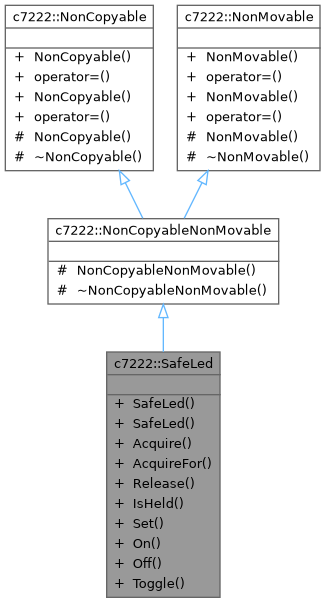
Public Member Functions | |
| SafeLed (Led &led) | |
| Construct a SafeLed wrapper around an existing Led instance. | |
| SafeLed (PicoWBoard::LedId id) | |
| Construct a SafeLed wrapper for a board LED by logical ID. | |
| void | Acquire () |
| Acquire exclusive control of the LED (blocks until available). | |
| bool | AcquireFor (uint32_t timeout) |
| Acquire exclusive control with a timeout. | |
| void | Release () |
| Release exclusive control of the LED. | |
| bool | IsHeld () const |
| Return true if this object currently holds the lock. | |
| void | Set (bool on) |
| Set the LED state (requires Acquire()). | |
| void | On () |
| Turn the LED on (requires Acquire()). | |
| void | Off () |
| Turn the LED off (requires Acquire()). | |
| void | Toggle () |
| Toggle the LED (requires Acquire()). | |
 Public Member Functions inherited from c7222::NonCopyable Public Member Functions inherited from c7222::NonCopyable | |
| NonCopyable (const NonCopyable &)=delete | |
| NonCopyable & | operator= (const NonCopyable &)=delete |
| NonCopyable (NonCopyable &&)=default | |
| NonCopyable & | operator= (NonCopyable &&)=default |
| Public Member Functions inherited from c7222::NonMovable | |
| NonMovable (const NonMovable &)=default | |
| NonMovable & | operator= (const NonMovable &)=default |
| NonMovable (NonMovable &&)=delete | |
| NonMovable & | operator= (NonMovable &&)=delete |
Additional Inherited Members | |
| Protected Member Functions inherited from c7222::NonCopyableNonMovable | |
| NonCopyableNonMovable ()=default | |
| ~NonCopyableNonMovable ()=default | |
| Protected Member Functions inherited from c7222::NonCopyable | |
| NonCopyable ()=default | |
| ~NonCopyable ()=default | |
| Protected Member Functions inherited from c7222::NonMovable | |
| NonMovable ()=default | |
| ~NonMovable ()=default | |
Detailed Description
LED wrapper that prevents simultaneous control from multiple threads.
Usage pattern:
- Call
Acquire()to obtain exclusive control. - Perform one or more LED operations.
- Call
Release()when done.
All LED operations assert that the caller has acquired the lock.
Synchronization model and purpose:
- Uses a
std::mutexto guard ownership state (locked_) across multiple tasks that may try to control the LED. - Uses a
std::condition_variableto block waiters inAcquire()/AcquireFor()until the LED becomes available, avoiding busy-waiting.
RAII considerations:
- RAII is intentionally not used to represent LED ownership because ownership spans multiple calls and can be transferred between tasks over time. A scoped guard would tie ownership to a single scope and thread, which does not match the intended usage pattern (press/release workflows).
- RAII is used internally for mutex management:
Acquire()/AcquireFor()usestd::unique_lockbecausestd::condition_variablerequires it for atomic unlock-and-wait semantics. The lock is released on all exit paths.
Constructor & Destructor Documentation
◆ SafeLed() [1/2]
|
explicit |
◆ SafeLed() [2/2]
|
inlineexplicit |
Construct a SafeLed wrapper for a board LED by logical ID.
This is a convenience constructor that looks up the LED from the Platform singleton. It assumes the Platform and PicoWBoard have been initialized and that the specified LED exists.
Member Function Documentation
◆ Acquire()
| void c7222::SafeLed::Acquire | ( | ) |
Acquire exclusive control of the LED (blocks until available).
◆ AcquireFor()
| bool c7222::SafeLed::AcquireFor | ( | uint32_t | timeout | ) |
Acquire exclusive control with a timeout.
- Parameters
-
timeout Maximum time to wait.
- Returns
- true if the lock was acquired, false on timeout.

◆ IsHeld()
| bool c7222::SafeLed::IsHeld | ( | ) | const |
Return true if this object currently holds the lock.
◆ Off()
| void c7222::SafeLed::Off | ( | ) |
Turn the LED off (requires Acquire()).


◆ On()
| void c7222::SafeLed::On | ( | ) |
Turn the LED on (requires Acquire()).


◆ Release()
| void c7222::SafeLed::Release | ( | ) |
Release exclusive control of the LED.

◆ Set()
| void c7222::SafeLed::Set | ( | bool | on | ) |

◆ Toggle()
| void c7222::SafeLed::Toggle | ( | ) |

The documentation for this class was generated from the following files:
- libs/elec_c7222/examples/freertos-device-cpp/safe_led.hpp
- libs/elec_c7222/examples/freertos-device-cpp/safe_led.cpp