Singleton access to platform-specific devices and initialization. More...
#include <platform.hpp>
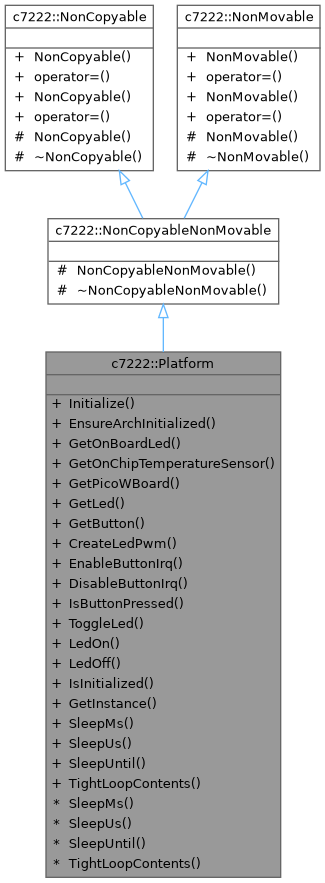
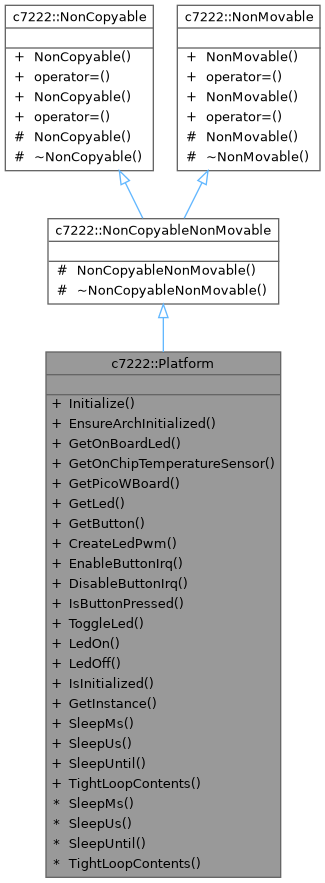
Public Member Functions | |
| bool | Initialize () |
| Initialize platform-specific hardware. | |
| bool | EnsureArchInitialized () |
| Ensure the platform architecture is initialized. | |
| OnBoardLED * | GetOnBoardLed () |
| Access the on-board LED. | |
| OnChipTemperatureSensor * | GetOnChipTemperatureSensor () |
| Access the on-chip temperature sensor. | |
| PicoWBoard * | GetPicoWBoard () |
| Access the PicoWBoard singleton. | |
| Led & | GetLed (PicoWBoard::LedId id) |
| Get a board LED by logical ID. | |
| Button & | GetButton (PicoWBoard::ButtonId id) |
| Get a board button by logical ID. | |
| std::unique_ptr< PwmOut > | CreateLedPwm (PicoWBoard::LedId id, uint8_t dim) |
| Create a PWM output for a board LED pin. | |
| void | EnableButtonIrq (PicoWBoard::ButtonId id, GpioInputEvent events, std::function< void(uint32_t)> handler) |
| Enable IRQs for a board button. | |
| void | DisableButtonIrq (PicoWBoard::ButtonId id) |
| Disable IRQs for a board button. | |
| bool | IsButtonPressed (PicoWBoard::ButtonId id) |
| Read the current state of a board button (true if pressed). | |
| void | ToggleLed (PicoWBoard::LedId id) |
| Toggle a board LED. | |
| void | LedOn (PicoWBoard::LedId id) |
| Turn a board LED on. | |
| void | LedOff (PicoWBoard::LedId id) |
| Turn a board LED off. | |
| bool | IsInitialized () const |
| Return true if platform initialization has completed. | |
 Public Member Functions inherited from c7222::NonCopyable Public Member Functions inherited from c7222::NonCopyable | |
| NonCopyable (const NonCopyable &)=delete | |
| NonCopyable & | operator= (const NonCopyable &)=delete |
| NonCopyable (NonCopyable &&)=default | |
| NonCopyable & | operator= (NonCopyable &&)=default |
| Public Member Functions inherited from c7222::NonMovable | |
| NonMovable (const NonMovable &)=default | |
| NonMovable & | operator= (const NonMovable &)=default |
| NonMovable (NonMovable &&)=delete | |
| NonMovable & | operator= (NonMovable &&)=delete |
Static Public Member Functions | |
| static Platform * | GetInstance () |
| Get the singleton instance. | |
Timing helpers | |
These static wrappers provide access to common Pico SDK timing utilities for main-loop control and low-power waiting. Callers may use these without a Platform instance. | |
| static void | SleepMs (uint32_t ms) |
| Sleep for a number of milliseconds. | |
| static void | SleepUs (uint64_t us) |
| Sleep for a number of microseconds. | |
| static void | SleepUntil (std::chrono::steady_clock::time_point target) |
| Sleep until a steady-clock time point. | |
| static void | TightLoopContents () |
| Body for tight polling loops (no-op hook). | |
Additional Inherited Members | |
| Protected Member Functions inherited from c7222::NonCopyableNonMovable | |
| NonCopyableNonMovable ()=default | |
| ~NonCopyableNonMovable ()=default | |
| Protected Member Functions inherited from c7222::NonCopyable | |
| NonCopyable ()=default | |
| ~NonCopyable ()=default | |
| Protected Member Functions inherited from c7222::NonMovable | |
| NonMovable ()=default | |
| ~NonMovable ()=default | |
Detailed Description
Singleton access to platform-specific devices and initialization.
Purpose:
- Centralizes platform initialization (Pico SDK / CYW43 setup) so application code does not need to call platform-specific init routines.
- Provides convenience accessors for common board devices (LEDs and buttons) while still allowing direct use of the dedicated device classes (
OnBoardLED,OnChipTemperatureSensor,PicoWBoard,Led,Button). - Exposes timing helpers for main-loop management (sleep and tight-loop utilities) in a consistent, platform-owned API.
Dependencies:
OnBoardLED: accessed viaGetOnBoardLed(); must be explicitly initialized by the user.OnChipTemperatureSensor: accessed viaGetOnChipTemperatureSensor(); must be explicitly initialized by the user.PicoWBoard: accessed viaGetPicoWBoard()and the convenience LED/button helpers; provides higher-level board IO access.- Pico timing helpers: exposed as static functions (see "Timing helpers").
Pico platform initialization:
Initialize()callsEnsureArchInitialized(), which initializes the Pico SDK architecture layer (including CYW43 on Pico W).- Device classes remain explicit-init so callers stay in control of when hardware is configured.
Proper usage:
- Always call
Platform::Initialize()once early. - Then explicitly initialize devices you intend to use (LED and temperature sensor).
- For board LEDs/buttons, use the convenience helpers or access
PicoWBoarddirectly.
Typical usage:
On-board LED (explicit init required):
Temperature sensor (explicit init required):
PicoWBoard LEDs and buttons:
Timing helpers:
Member Function Documentation
◆ CreateLedPwm()
| std::unique_ptr< PwmOut > c7222::Platform::CreateLedPwm | ( | PicoWBoard::LedId | id, |
| uint8_t | dim | ||
| ) |
Create a PWM output for a board LED pin.
- Parameters
-
id Board LED identifier. dim Brightness 0-255 (0 = off, 255 = fully on).
- Returns
- Unique pointer to a PWM output configured for the LED pin.
Notes:
- Board LEDs are active-low, so the PWM output is configured as active-low.
- Do not drive the same pin with
LedandPwmOutat the same time. If you previously usedLed, stop using it and allow PWM to take over.

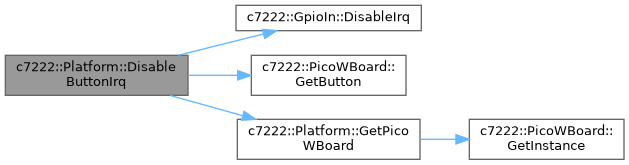
◆ DisableButtonIrq()
|
inline |
Disable IRQs for a board button.
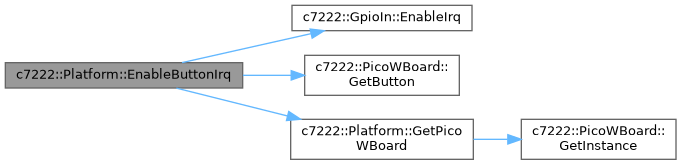
◆ EnableButtonIrq()
|
inline |
Enable IRQs for a board button.

◆ EnsureArchInitialized()
| bool c7222::Platform::EnsureArchInitialized | ( | ) |
Ensure the platform architecture is initialized.
- Returns
- true when architecture init succeeds.
◆ GetButton()
|
inline |
Get a board button by logical ID.

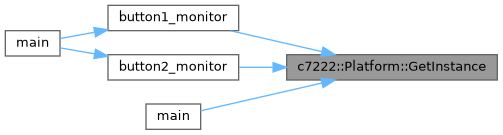
◆ GetInstance()
|
static |
Get the singleton instance.
◆ GetLed()
|
inline |
Get a board LED by logical ID.


◆ GetOnBoardLed()
|
inline |
Access the on-board LED.
Note: Call Initialize() first. The LED's own Initialize() must be called explicitly by the user; Platform does not auto-initialize it.
Example:
Access the on-board LED singleton.

◆ GetOnChipTemperatureSensor()
|
inline |
Access the on-chip temperature sensor.
Note: Call Initialize() first. The sensor's own Initialize() must be called explicitly by the user; Platform does not auto-initialize it.
Example:
Access the on-chip temperature sensor singleton.

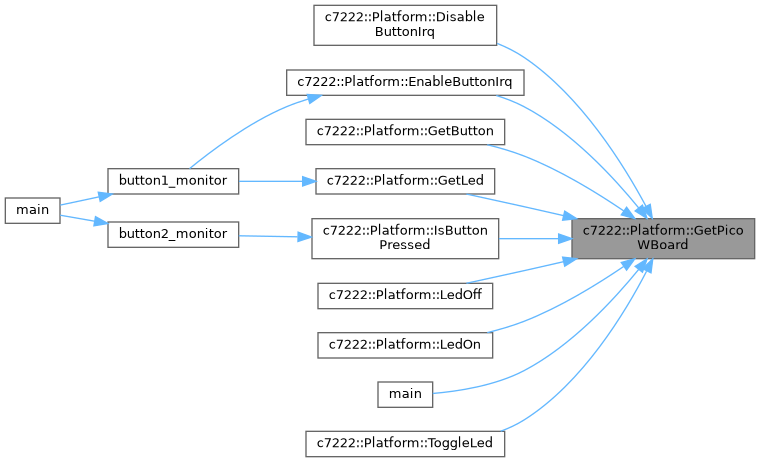
◆ GetPicoWBoard()
|
inline |
Access the PicoWBoard singleton.

◆ Initialize()
| bool c7222::Platform::Initialize | ( | ) |
Initialize platform-specific hardware.
This performs architecture-level initialization (e.g., CYW43 on Pico W). It does not automatically initialize the on-board LED or temperature sensor; those must be initialized explicitly by the user.
- Returns
- true when initialization succeeds.

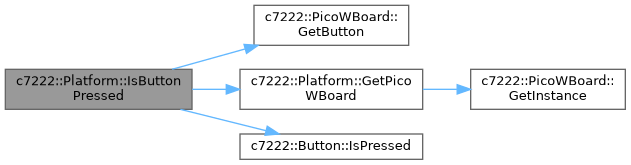
◆ IsButtonPressed()
|
inline |
Read the current state of a board button (true if pressed).

◆ IsInitialized()
|
inline |
Return true if platform initialization has completed.
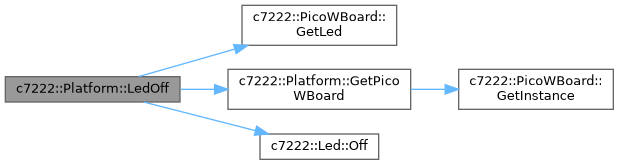
◆ LedOff()
|
inline |
Turn a board LED off.
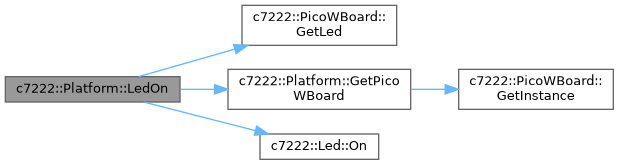
◆ LedOn()
|
inline |
Turn a board LED on.
◆ SleepMs()
|
static |
Sleep for a number of milliseconds.
- Parameters
-
ms Milliseconds to sleep.
◆ SleepUntil()
|
static |
Sleep until a steady-clock time point.
- Parameters
-
target Target time point.
◆ SleepUs()
|
static |
Sleep for a number of microseconds.
- Parameters
-
us Microseconds to sleep.
◆ TightLoopContents()
|
static |
Body for tight polling loops (no-op hook).
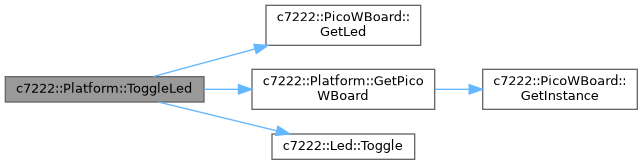
◆ ToggleLed()
|
inline |
Toggle a board LED.
The documentation for this class was generated from the following file:
- libs/elec_c7222/devices/include/platform.hpp