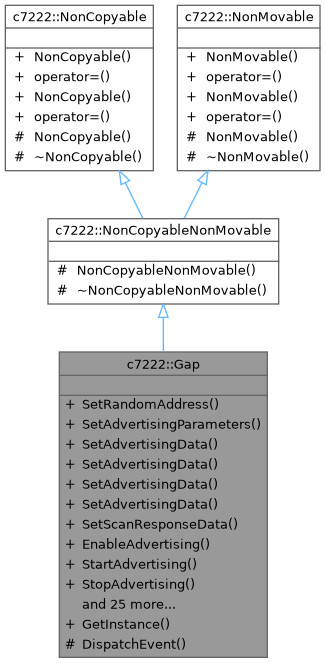
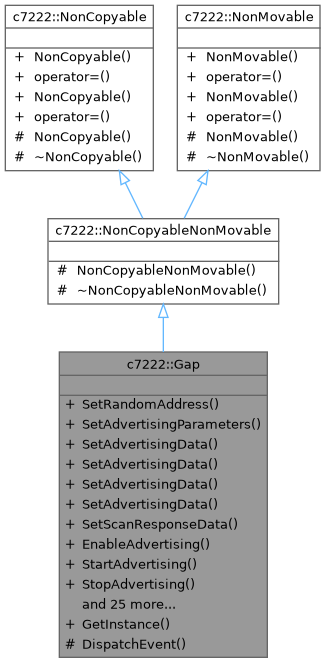
Manages Generic Access Profile (GAP) functionality for BLE. More...
#include <gap.hpp>
Classes | |
| struct | AdvertisementParameters |
| struct | AdvertisingReport |
| struct | ConnectionParameters |
| struct | EventHandler |
| struct | ExtendedAdvertisingReport |
| struct | InquiryResult |
| struct | PreferredConnectionParameters |
Public Member Functions | |
| void | SetRandomAddress (const BleAddress &address) |
| Set a fixed random address for advertising. | |
| void | SetAdvertisingParameters (const AdvertisementParameters ¶ms) |
| Configure legacy advertising parameters. | |
| void | SetAdvertisingData (const uint8_t *data, size_t size) |
| Set legacy advertising data payload. | |
| void | SetAdvertisingData (const std::vector< uint8_t > &data) |
| Set legacy advertising data payload from a vector. | |
| void | SetAdvertisingData (const AdvertisementDataBuilder &data_builder) |
| Set legacy advertising data payload from an AdvertisementDataBuilder. | |
| void | SetAdvertisingData () |
| Set legacy advertising data payload from the internal builder. | |
| void | SetScanResponseData (uint8_t length, const uint8_t *data) |
| Set scan response data payload (ADV_SCAN_IND). | |
| void | EnableAdvertising (bool enabled) |
| Enable or disable advertising. | |
| void | StartAdvertising () |
| Convenience helpers for starting/stopping advertising. | |
| void | StopAdvertising () |
| BleError | RequestConnectionParameterUpdate (ConnectionHandle con_handle, const PreferredConnectionParameters ¶ms) |
| Request a connection parameter update (peripheral role). | |
| BleError | UpdateConnectionParameters (ConnectionHandle con_handle, const PreferredConnectionParameters ¶ms) |
| Update connection parameters (central role). | |
| BleError | ReadRssi (ConnectionHandle con_handle) |
| Read the RSSI for a connection. | |
| BleError | Disconnect (ConnectionHandle con_handle) |
| Disconnect a connection by handle. | |
| void | SetLocalAddress (BleAddress &address) |
| Read the local device address. | |
| void | AddEventHandler (const EventHandler &handler) |
| Register an event handler. | |
| bool | RemoveEventHandler (const EventHandler &handler) |
| Unregister an event handler. | |
| void | ClearEventHandlers () |
| Clear all registered event handlers. | |
| std::list< const EventHandler * > | GetEventHandlers () const |
| Get the list of registered event handlers. | |
| bool | GetConnectionParameters (ConnectionHandle con_handle, ConnectionParameters &out) const |
| Get cached connection parameters for a handle. | |
| bool | IsAdvertisingEnabled () const |
| Check if advertising is currently enabled. | |
| bool | IsAdvertising () const |
| Check if advertising is currently running on the controller. | |
| bool | IsAdvertisingParametersSet () const |
| Check if advertising parameters have been set. | |
| bool | IsConnected () const |
| Check if a connection is active. | |
| bool | GetRandomAddress (BleAddress &address) const |
| Get the random address if set. | |
| bool | IsRandomAddressSet () const |
| Check if a random address has been set. | |
| bool | GetAdvertisingParameters (AdvertisementParameters ¶ms) const |
| Get the current advertising parameters. | |
| const std::vector< uint8_t > & | GetAdvertisingData () const |
| Get the advertising data payload. | |
| AdvertisementDataBuilder & | GetAdvertisementDataBuilder () |
| Access the internal advertisement data builder. | |
| const AdvertisementDataBuilder & | GetAdvertisementDataBuilder () const |
| Access the internal advertisement data builder (const). | |
| bool | IsAdvertisingDataSet () const |
| Check if advertising data has been set. | |
| const std::vector< uint8_t > & | scan_response_data () const |
| Get the scan response data payload. | |
| bool | IsScanResponseDataSet () const |
| Check if scan response data has been set. | |
| const std::map< ConnectionHandle, ConnectionParameters > & | GetConnectionParameters () const |
| Access the cached connection parameter map. | |
| virtual BleError | DispatchBleHciPacket (uint8_t packet_type, const uint8_t *packet_data, uint16_t packet_data_size) |
| Dispatch a raw HCI packet into the GAP event pipeline. | |
 Public Member Functions inherited from c7222::NonCopyable Public Member Functions inherited from c7222::NonCopyable | |
| NonCopyable (const NonCopyable &)=delete | |
| NonCopyable & | operator= (const NonCopyable &)=delete |
| NonCopyable (NonCopyable &&)=default | |
| NonCopyable & | operator= (NonCopyable &&)=default |
| Public Member Functions inherited from c7222::NonMovable | |
| NonMovable (const NonMovable &)=default | |
| NonMovable & | operator= (const NonMovable &)=default |
| NonMovable (NonMovable &&)=delete | |
| NonMovable & | operator= (NonMovable &&)=delete |
Static Public Member Functions | |
| static Gap * | GetInstance () |
| Get the singleton instance. | |
Protected Member Functions | |
| virtual BleError | DispatchEvent (EventId event_id, const uint8_t *event_data, uint16_t event_data_size) |
| Dispatch a mapped GAP event to registered handlers. | |
| Protected Member Functions inherited from c7222::NonCopyableNonMovable | |
| NonCopyableNonMovable ()=default | |
| ~NonCopyableNonMovable ()=default | |
| Protected Member Functions inherited from c7222::NonCopyable | |
| NonCopyable ()=default | |
| ~NonCopyable ()=default | |
| Protected Member Functions inherited from c7222::NonMovable | |
| NonMovable ()=default | |
| ~NonMovable ()=default | |
Detailed Description
Manages Generic Access Profile (GAP) functionality for BLE.
This class provides a high-level, object-oriented interface for managing the BLE GAP layer, acting as a C++ wrapper around the underlying C-based BTstack API. It simplifies common GAP operations such as advertising and connection management by maintaining state and handling HCI event dispatching. Scanning is currently exposed only via events, not via public start/stop APIs.
The Gap class is implemented as a singleton, accessible via GetInstance(), ensuring a single point of control for the device's GAP layer.
Design Logic
The class abstracts away the low-level details of the BTstack. It works by:
- Configuration Caching: Storing advertising parameters, data, and other settings within the class.
- State Management: Tracking the advertising state (
IsAdvertisingEnabled()) and connection status (IsConnected()). - Event-Driven Callbacks: Using the
EventHandlerinterface, which users can implement to react to BLE events (e.g., connection, disconnection, advertising reports) in a clean, C++ idiomatic way. - HCI Event Dispatching: The
DispatchBleHciPacketmethod is the entry point for raw HCI events from the BTstack, which are then parsed and forwarded to the appropriateEventHandlermethods. Your application must call this for events to reach the handlers.
Advertising Configuration (Legacy)
To start advertising, you must configure three main components:
- Advertising Parameters: Define the "how" of advertising.
- Type: Connectable, scannable, non-connectable, etc.
- Interval: The frequency of advertising packets.
- Channels: Which BLE channels to advertise on. This is configured using
SetAdvertisingParameters().
- Advertising Data: The main payload (up to 31 bytes) that is broadcast to all listening devices. This typically includes flags and the device name. This is configured using
SetAdvertisingData(). - Scan Response Data (Optional): An additional 31-byte payload that a central device can request after seeing the initial advertisement. This is often used for supplementary information that doesn't fit in the main payload. This is configured using
SetScanResponseData().
Applying Configurations and Utilities
- **
SetAdvertisingParameters(const AdvertisementParameters& params):** Takes a struct that defines the advertising behavior. A default-constructedAdvertisementParametersprovides standard connectable, undirected advertising settings. - **
SetAdvertisingData(...)/SetScanResponseData(...):** These methods accept a raw pointer and length. For convenience,SetAdvertisingDatais overloaded to accept astd::vector<uint8_t>or anAdvertisementDataBuilderinstance, which is the recommended utility for safely constructing valid advertising payloads. - **
StartAdvertising()/StopAdvertising():** Simple methods to enable or disable advertising.
Dynamic Data Updates
You can update advertising or scan response data at any time, even while advertising is active. The SetAdvertisingData and SetScanResponseData methods will automatically handle the underlying requirements of the RPi Pico BLE stack: they temporarily stop advertising, apply the new data, and restart advertising if it was previously enabled. This ensures a seamless update without manual intervention.
Limitations / Future Work
- Extended advertising: not implemented in this wrapper yet. The API only supports legacy advertising (31-byte payloads, ADV_* types).
- Scanning control: scan start/stop configuration is not exposed yet. Only scan-related events are surfaced via
EventHandler.
Complete Code Example (Peripheral / Advertising)
Below is a complete example of setting up and starting a connectable BLE advertisement with a device name. It also shows a minimal event dispatch hook that forwards BTstack HCI events into the Gap instance.
Minimal Event-Only Example (e.g., central role)
If another component configures scanning or connections, you can still use Gap for event handling by registering a handler and dispatching HCI events.
Member Enumeration Documentation
◆ AdvertisingChannelMap
|
strong |
◆ AdvertisingEventType
|
strong |
Extended advertising event properties (bitfield).
◆ AdvertisingFilterPolicy
|
strong |
Advertising filter policy.
◆ AdvertisingType
|
strong |
Legacy advertising types for LE advertising parameters.
◆ DirectAddressType
|
strong |
◆ EventId
|
strong |
Event IDs used by Gap::EventHandler.
◆ Phy
|
strong |
Member Function Documentation
◆ AddEventHandler()
| void c7222::Gap::AddEventHandler | ( | const EventHandler & | handler | ) |
Register an event handler.
The handler is stored as a pointer; it must outlive the Gap instance.

◆ ClearEventHandlers()
| void c7222::Gap::ClearEventHandlers | ( | ) |
Clear all registered event handlers.
- Note
- The handler instances are not deleted by this method. Therefore, the caller must delete the objects if they were dynamically allocated.

◆ Disconnect()
| BleError c7222::Gap::Disconnect | ( | ConnectionHandle | con_handle | ) |
Disconnect a connection by handle.

◆ DispatchBleHciPacket()
|
virtual |
Dispatch a raw HCI packet into the GAP event pipeline.
- Parameters
-
packet_type HCI packet type (expected HCI_EVENT_PACKET). packet_data Pointer to packet bytes. packet_data_size Packet length in bytes.
- Returns
- BLE error status.
◆ DispatchEvent()
|
protectedvirtual |
Dispatch a mapped GAP event to registered handlers.
- Parameters
-
event_id Mapped GAP event ID. event_data Pointer to event data bytes. event_data_size Event length in bytes.
- Returns
- BLE error status.
◆ EnableAdvertising()
| void c7222::Gap::EnableAdvertising | ( | bool | enabled | ) |
Enable or disable advertising.

◆ GetAdvertisementDataBuilder() [1/2]
|
inline |
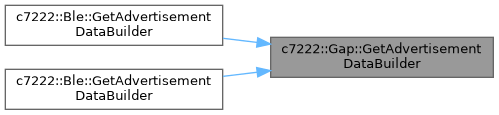
Access the internal advertisement data builder.
Use this to assemble the legacy advertising payload before applying it with SetAdvertisingData().
◆ GetAdvertisementDataBuilder() [2/2]
|
inline |
Access the internal advertisement data builder (const).
◆ GetAdvertisingData()
|
inline |
Get the advertising data payload.
- Returns
- Pointer to advertising data, or nullptr if not set.

◆ GetAdvertisingParameters()
| bool c7222::Gap::GetAdvertisingParameters | ( | AdvertisementParameters & | params | ) | const |
Get the current advertising parameters.
- Parameters
-
params Output parameters.
- Returns
- true if advertising parameters have been set.
◆ GetConnectionParameters() [1/2]
|
inline |
Access the cached connection parameter map.
The map is populated from connection-related events.
◆ GetConnectionParameters() [2/2]
| bool c7222::Gap::GetConnectionParameters | ( | ConnectionHandle | con_handle, |
| ConnectionParameters & | out | ||
| ) | const |
Get cached connection parameters for a handle.
- Parameters
-
con_handle Connection handle. out Parameters output.
- Returns
- true if parameters are known for the handle.
◆ GetEventHandlers()
|
inline |
Get the list of registered event handlers.
◆ GetInstance()
|
static |
Get the singleton instance.
◆ GetRandomAddress()
| bool c7222::Gap::GetRandomAddress | ( | BleAddress & | address | ) | const |
Get the random address if set.
- Parameters
-
address Output address.
- Returns
- true if a random address has been set.
◆ IsAdvertising()
|
inline |
Check if advertising is currently running on the controller.
This follows stack events and is set true after a successful OnAdvertisingStart callback, and set false before an OnAdvertisingEnd callback.
◆ IsAdvertisingDataSet()
|
inline |
Check if advertising data has been set.
◆ IsAdvertisingEnabled()
|
inline |
Check if advertising is currently enabled.

◆ IsAdvertisingParametersSet()
|
inline |
Check if advertising parameters have been set.
◆ IsConnected()
|
inline |
Check if a connection is active.

◆ IsRandomAddressSet()
|
inline |
Check if a random address has been set.
◆ IsScanResponseDataSet()
|
inline |
Check if scan response data has been set.
◆ ReadRssi()
| BleError c7222::Gap::ReadRssi | ( | ConnectionHandle | con_handle | ) |
Read the RSSI for a connection.

◆ RemoveEventHandler()
| bool c7222::Gap::RemoveEventHandler | ( | const EventHandler & | handler | ) |
Unregister an event handler.
- Returns
- true if the handler was found and removed.
- Note
- Handlers are compared by pointer address. If multiple identical handlers were added, only the first is removed.
- Removing a handler that was not registered has no effect.
- Do not remove handlers while iterating through the handler list (e.g. during event dispatch). It is NOT safe to remove handlers from within event callbacks.
- The handler instance is not deleted by this method. Therefore, the caller must delete the object if it was dynamically allocated.

◆ RequestConnectionParameterUpdate()
| BleError c7222::Gap::RequestConnectionParameterUpdate | ( | ConnectionHandle | con_handle, |
| const PreferredConnectionParameters & | params | ||
| ) |
Request a connection parameter update (peripheral role).

◆ scan_response_data()
|
inline |
Get the scan response data payload.
- Returns
- Pointer to scan response data, or nullptr if not set.
◆ SetAdvertisingData() [1/4]
|
inline |
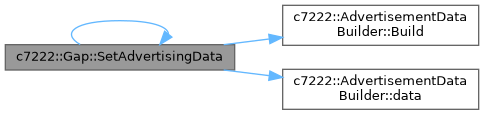
Set legacy advertising data payload from the internal builder.
Asserts that the builder contains at least one AD structure and validates.

◆ SetAdvertisingData() [2/4]
| void c7222::Gap::SetAdvertisingData | ( | const AdvertisementDataBuilder & | data_builder | ) |
Set legacy advertising data payload from an AdvertisementDataBuilder.
- Parameters
-
data_builder AdvertisementDataBuilder instance containing the payload.
- Note
- The data from the builder is copied.
◆ SetAdvertisingData() [3/4]
|
inline |
Set legacy advertising data payload from a vector.
- Parameters
-
data Advertising data payload.

◆ SetAdvertisingData() [4/4]
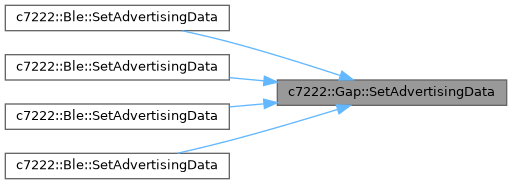
| void c7222::Gap::SetAdvertisingData | ( | const uint8_t * | data, |
| size_t | size | ||
| ) |
Set legacy advertising data payload.
The payload is copied into the internal advertisement data builder and then applied to BTstack immediately.
◆ SetAdvertisingParameters()
| void c7222::Gap::SetAdvertisingParameters | ( | const AdvertisementParameters & | params | ) |
Configure legacy advertising parameters.

◆ SetLocalAddress()
| void c7222::Gap::SetLocalAddress | ( | BleAddress & | address | ) |
Read the local device address.
◆ SetRandomAddress()
| void c7222::Gap::SetRandomAddress | ( | const BleAddress & | address | ) |
Set a fixed random address for advertising.

◆ SetScanResponseData()
| void c7222::Gap::SetScanResponseData | ( | uint8_t | length, |
| const uint8_t * | data | ||
| ) |
Set scan response data payload (ADV_SCAN_IND).

◆ StartAdvertising()
| void c7222::Gap::StartAdvertising | ( | ) |
Convenience helpers for starting/stopping advertising.

◆ StopAdvertising()
| void c7222::Gap::StopAdvertising | ( | ) |

◆ UpdateConnectionParameters()
| BleError c7222::Gap::UpdateConnectionParameters | ( | ConnectionHandle | con_handle, |
| const PreferredConnectionParameters & | params | ||
| ) |
Update connection parameters (central role).

The documentation for this class was generated from the following file:
- libs/elec_c7222/ble/gap/include/gap.hpp