FreeRTOS C++ device example demonstrating buttons, LEDs, PWM, and synchronization. More...
#include <cassert>#include <thread>#include <chrono>#include <cstdio>#include "freertos_task.hpp"#include "freertos_timer.hpp"#include "gpio.hpp"#include "platform.hpp"#include "button_event.hpp"#include "pwm.hpp"#include "safe_led.hpp"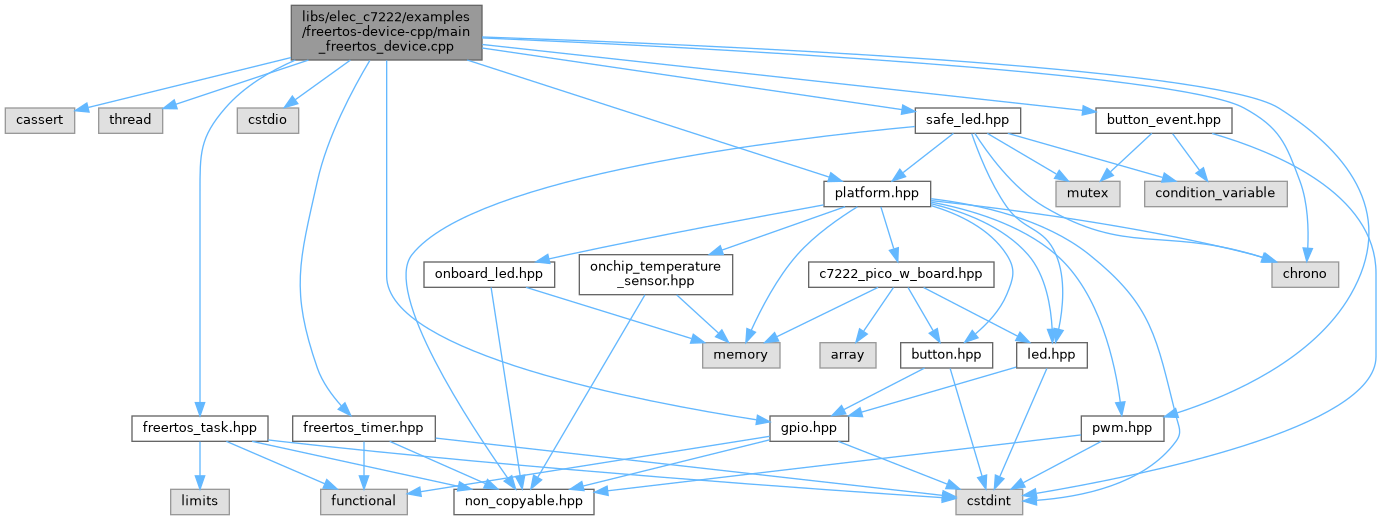
Functions | |
| void | button1_irq_dispatcher (void *arg) |
| Timer callback that publishes Button 1 events to the task. | |
| void | button1_irq_handler (uint32_t events) |
| GPIO IRQ handler for Button 1. | |
| void | button1_monitor (void *param) |
| Button 1 monitoring task. | |
| void | button2_monitor (void *param) |
| Button 2 monitoring task. | |
| void | system_monitor (void *param) |
| Periodic system task that blinks the shared system LED. | |
| int | main () |
| Program entry point. | |
Variables | |
| c7222::FreeRtosTimer * | dispatcher_timer = nullptr |
| One-shot timer used to defer GPIO IRQ handling to the timer task. | |
| c7222::ButtonEvent | button1_event |
| Thread-safe event mailbox for Button 1 IRQ events. | |
| c7222::SafeLed * | system_led = nullptr |
| Shared LED protected by SafeLed for multi-task coordination. | |
| std::unique_ptr< c7222::PwmOut > | pwm_led3_red = nullptr |
| PWM-controlled LED instance (LED3_RED). | |
| float | duty_cycle = 1.0f |
| Current PWM duty cycle used to dim LED3_RED. | |
Detailed Description
FreeRTOS C++ device example demonstrating buttons, LEDs, PWM, and synchronization.
Purpose of this example:
- Show how to use the C++ device wrappers (GPIO/LED/Button/PWM) with FreeRTOS-CPP11 on the Pico W platform.
- Demonstrate safe cross-task access to a shared LED using a mutex/condition_variable via the SafeLed helper.
- Demonstrate event delivery from a GPIO ISR to normal task context using a FreeRTOS software timer and the ButtonEvent helper class.
Devices and objects used:
- Board LEDs (LED1_GREEN, LED2_RED, LED2_GREEN) via
LedandSafeLed. - Board buttons (BUTTON_B1, BUTTON_B2) via
Button/GPIO IRQ and polling helpers. - PWM output for LED3_RED via
PwmOutto demonstrate duty-cycle control. - FreeRTOS wrapper classes (
FreeRtosTimer,FreeRtosTask) to defer ISR work to task context and use wrapper delay/scheduler helpers.
Concurrency and synchronization:
std::threadis used to create FreeRTOS tasks through FreeRTOS-CPP11 integration.ButtonEventusesstd::mutex+std::condition_variableto provide a wait-with-timeout event mailbox for button IRQ events.SafeLedusesstd::mutex+std::condition_variableto serialize access to a shared LED across multiple tasks.
Helper classes:
ButtonEventcollects IRQ events and provides a blockingGetEvents()API.SafeLedensures exclusive LED control between tasks, avoiding concurrent writes.
ISR dispatching model:
- The GPIO ISR for Button 1 records the event and starts a one-shot
FreeRtosTimer, passing the event bitmask as avoid*argument. - The timer callback runs in the FreeRTOS timer service task (normal execution context) and forwards the event to
ButtonEvent.
ButtonEvent dispatch via one-shot timer (detailed flow):
- A GPIO interrupt fires for BUTTON_B1 and
button1_irq_handlerruns in IRQ context. - The ISR does minimal work: it starts a one-shot
FreeRtosTimerand passes the event bitmask as the timer'scallback_arg(no heavy logic in IRQ). - When the timer expires,
button1_irq_dispatcherruns in the FreeRTOS timer service task (normal task context). - The dispatcher converts the
void*argument back to the event bitmask and callsbutton1_event.SetEvents(events), which notifies the waiting task. - The
button1_monitortask unblocks inGetEvents()and processes the event.
System LED behavior:
- The system LED (LED1_GREEN) is shared by
button2_monitorandsystem_monitor. - When Button 2 is pressed,
button2_monitortries to acquire the LED; if it succeeds, the LED stays on while the button remains pressed, then turns off on release. - When Button 2 is not holding the LED,
system_monitorblinks it by acquiring the LED for 500 ms, turning it on, then off and releasing it.
Function Documentation
◆ button1_irq_dispatcher()
| void button1_irq_dispatcher | ( | void * | arg | ) |
Timer callback that publishes Button 1 events to the task.
This runs in the FreeRTOS timer service task context, not in interrupt context. It pushes the event bitmask into ButtonEvent.


◆ button1_irq_handler()
| void button1_irq_handler | ( | uint32_t | events | ) |
GPIO IRQ handler for Button 1.
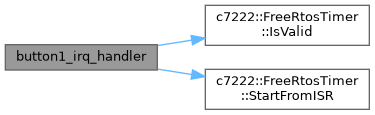
Runs in IRQ context. It must be minimal, so it schedules the dispatcher timer and passes the event bitmask as the timer callback argument.

◆ button1_monitor()
| void button1_monitor | ( | void * | param | ) |
Button 1 monitoring task.
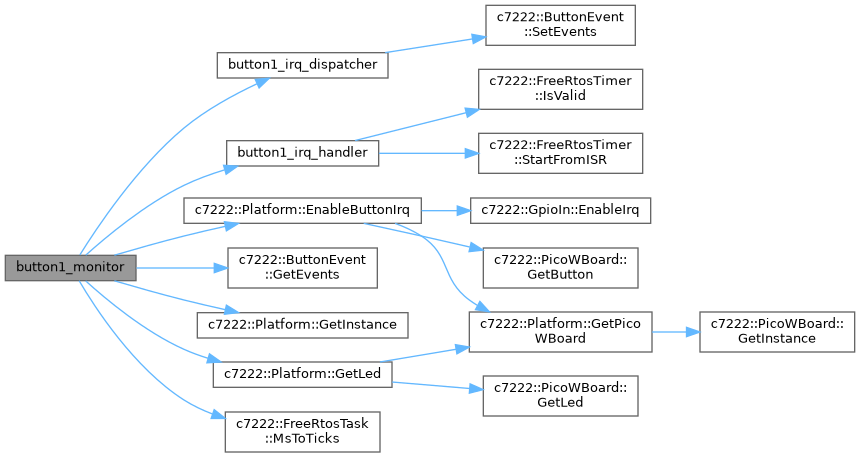
- Arms the IRQ and the dispatcher timer.
- Waits for events using ButtonEvent (condition-variable backed).
- Toggles LED2_GREEN on timeout (heartbeat).
- On press, turns LED2_RED on and decreases LED3_RED PWM duty cycle, which decreases brightness.
- On release, turns LED2_RED off.

◆ button2_monitor()
| void button2_monitor | ( | void * | param | ) |
Button 2 monitoring task.
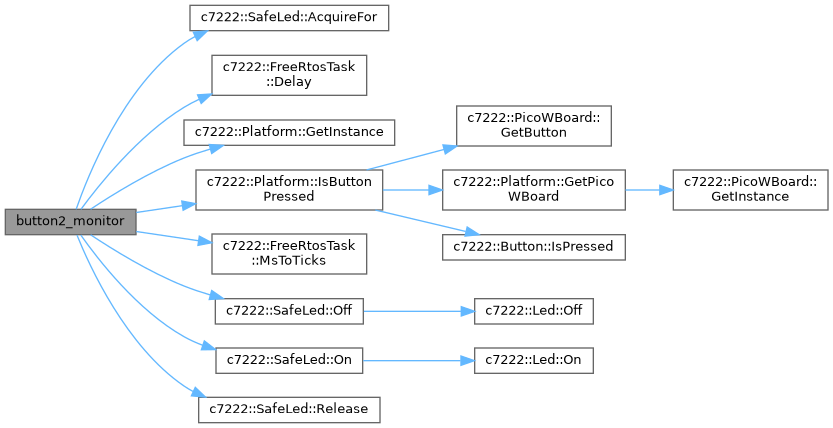
Uses polling (every 100 ms) and coordinates access to the shared system LED via SafeLed. This demonstrates cross-task protection of a shared LED.

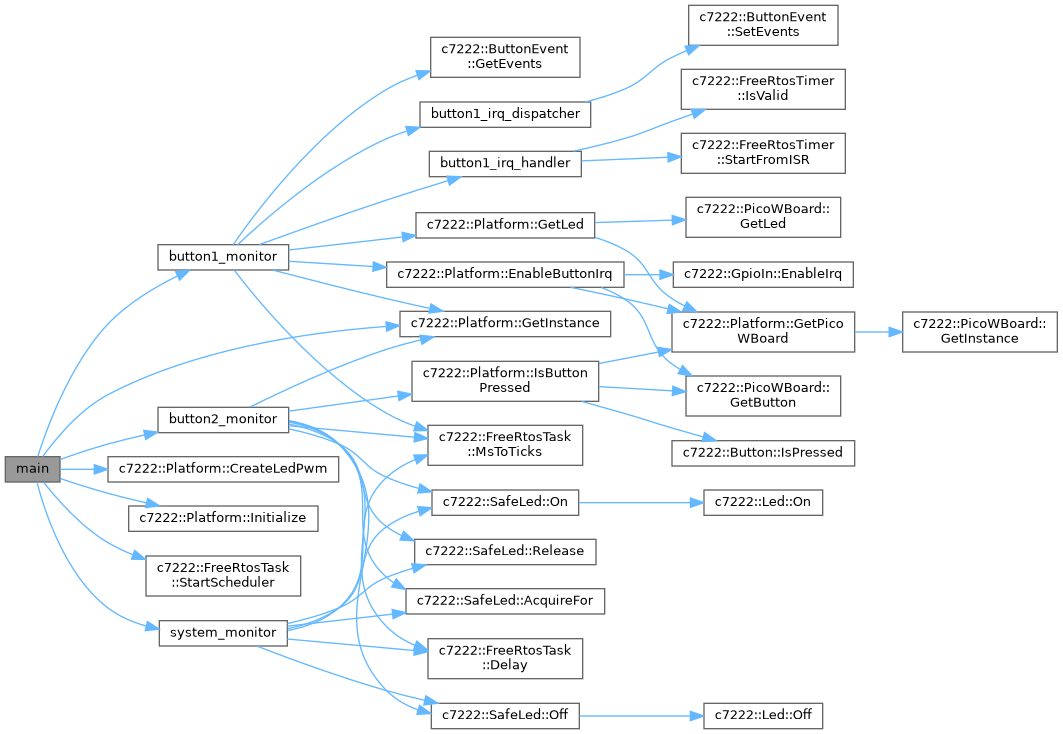
◆ main()
| int main | ( | void | ) |
Program entry point.
◆ system_monitor()
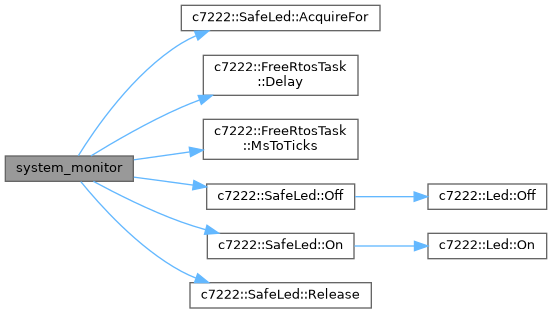
| void system_monitor | ( | void * | param | ) |
Periodic system task that blinks the shared system LED.
It attempts to acquire the SafeLed with a timeout to avoid blocking indefinitely when another task holds the LED.

Variable Documentation
◆ button1_event
| c7222::ButtonEvent button1_event |
Thread-safe event mailbox for Button 1 IRQ events.
Producers: the timer callback (not ISR). Consumers: the Button 1 monitor task.
◆ dispatcher_timer
| c7222::FreeRtosTimer* dispatcher_timer = nullptr |
One-shot timer used to defer GPIO IRQ handling to the timer task.
The ISR records the event and starts this timer. When it fires, it runs in the FreeRTOS timer service task and signals the ButtonEvent object.
◆ duty_cycle
| float duty_cycle = 1.0f |
Current PWM duty cycle used to dim LED3_RED.
◆ pwm_led3_red
| std::unique_ptr<c7222::PwmOut> pwm_led3_red = nullptr |
PWM-controlled LED instance (LED3_RED).
◆ system_led
| c7222::SafeLed* system_led = nullptr |
Shared LED protected by SafeLed for multi-task coordination.